About Portable Ground Water Monitor
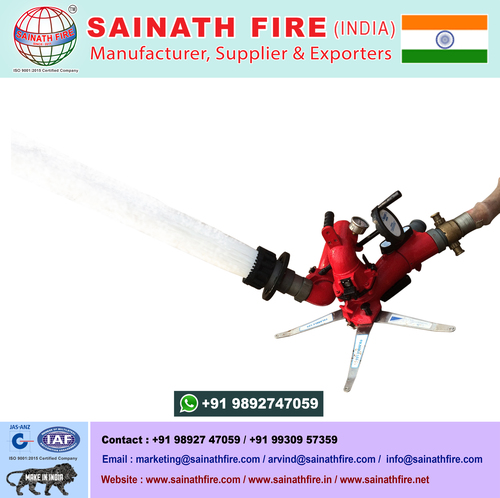
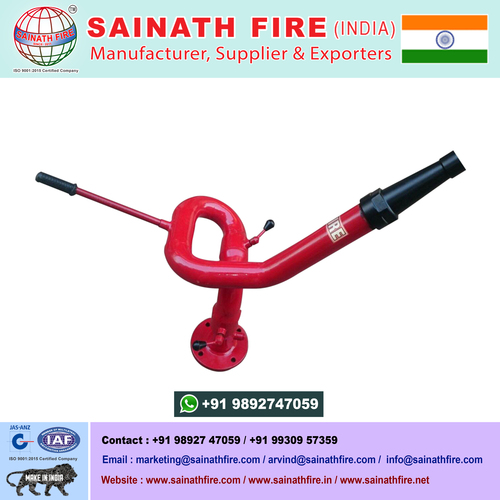
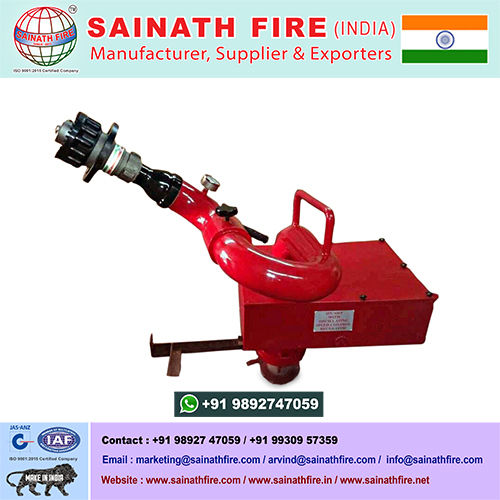
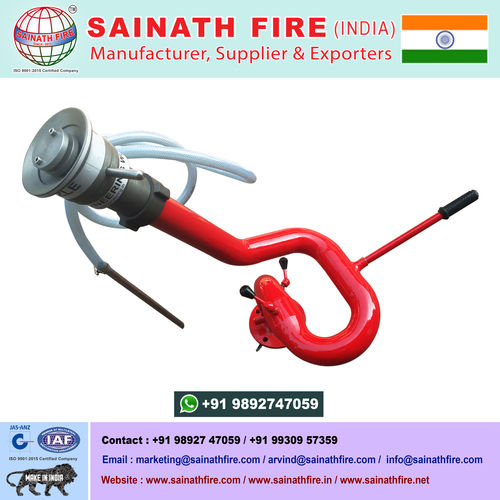
This aluminium cast Portable Ground Water Monitor is designed for multiple uses. This Portable Ground Water Monitor can be rotated to 180 degrees in portable mode and 360 degrees in stand post mode. The automatic valve drain fitted in this monitor offers stable water flow at higher pressure. This water monitor has higher durability and requires less maintenance. The higher pressure of water can be easily reached at longer distance with the help of water fog nozzle pattern. A wide range of this water monitor is offered in different specifications according to the requirement.
Specification:
- Multiple usege Portable ground Monitor
- 360 degree Horizontal rotation and standpost mode
- 180 Degree rotation portable made.
- Vertical traverse + 35 Degree to + 90 Degree with safety lock -45 degree to + 90 Degree removal
- Nozzle - Jet / Spray
- Technical Specification
- Automatic Drain Valve.
- Alu. casting Monitor
- Hard Coat Anodized Aluminum.
- Alloy With Red Colour Powder Coat
- Inlet For The Monitor 2.5" , Inlet 63mm Male
- Water Fog Nozzle Pattern
- Hallo jet/Straight stream Flow
Comprehensive Water Quality MeasurementThis monitor delivers real-time readings for six key groundwater quality parameters, including pH, EC, DO, TDS, temperature, and ORP. Its electronic water level sensor technology ensures high accuracy, making it indispensable for field professionals who require efficient, reliable data collection.
Durable and Portable DesignCrafted with stainless steel and non-corrosive ABS plastic, the device thrives under demanding field conditions. At just 0.9 kg, the cylindrical probe and reel setup allow easy transport and installation, whether handheld or ground standing. Its IP65-class enclosure provides dust and water splash resistance.
User-Friendly Operation and Data HandlingThe monitor features user-calibratable sensors, simple manual or automatic control, and a clear digital LCD/LED display for straightforward operation. Internal memory stores logged results, and the system offers a portable, low-power solution for continuous groundwater monitoring with standard cable reel options up to 150 meters.
FAQs of Portable Ground Water Monitor:
Q: How does the portable ground water monitor store and display measurement data?
A: The device is equipped with internal memory that logs and stores results during field monitoring. A digital LCD/LED display presents real-time parameter values, making it easy to review readings on-site without additional accessories.
Q: What steps are required to calibrate the sensors before using the monitor in the field?
A: To calibrate, follow the straightforward user-calibratable procedure outlined in the user manual. Calibration solutions for each parameter (pH, EC, DO, etc.) should be used, and the process can be completed prior to field deployment to ensure optimal accuracy.
Q: When should the monitors battery be replaced or recharged?
A: The monitor offers up to 10 hours of continuous use. For extended field sessions, ensure batteries are recharged or carry a replaceable set. Replace or recharge once low-battery indications appear on the display to avoid data loss during operation.
Q: Where can this device be effectively deployed for groundwater monitoring?
A: The rugged, portable design and IP65 rating make the monitor suitable for field installations in diverse environmentsfrom construction sites and agricultural fields to industrial zones and remote research locations within India and internationally.
Q: What are the main benefits of using a field-portable groundwater monitor?
A: The main benefits include real-time measurements, portability, lightweight construction, and on-site data logging. Its quick deployment, battery operation, and audio-visual alarms provide rapid, dependable groundwater assessments with minimal setup.
Q: How is the probe installed and operated during groundwater level measurements?
A: The cylindrical stainless steel probe is connected to a standard cable reel (available in 50m, 100m, or 150m lengths) and positioned into boreholes or wells. Both manual and automatic modes allow the user flexibility in operation according to specific monitoring requirements.





 Send Inquiry
 Send Inquiry

